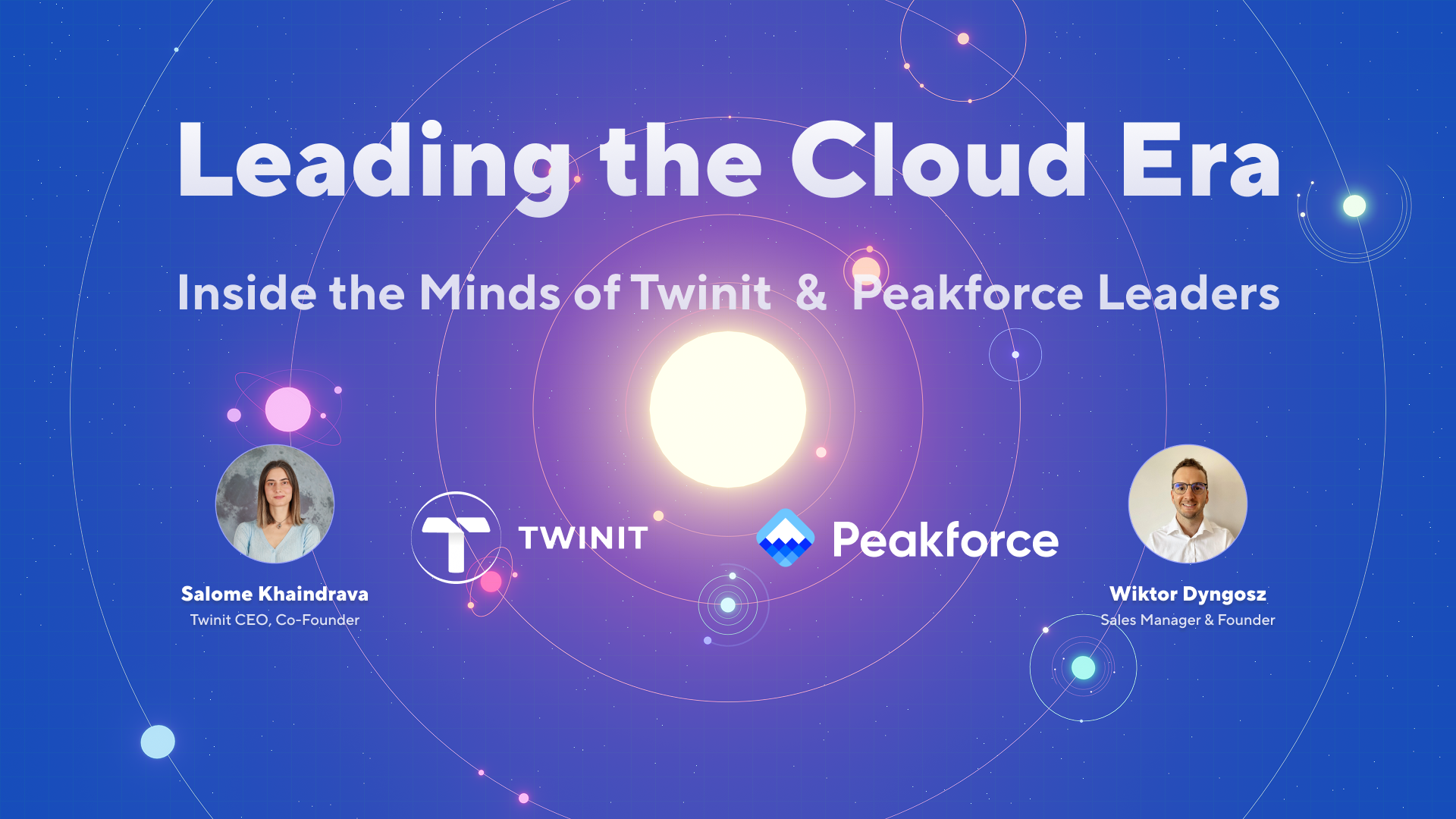
In today’s fast-evolving Atlassian ecosystem, collaboration between Solution Partners and Marketplace Partners is becoming more essential than ever. To explore how joint expertise accelerates cloud transformation and strengthens customer success, we sat down with the Founders of Peakforce and Twinit for an in-depth conversation about strategy, innovation, and the future of Cloud.
Twinit - Salome Khaindrava, CEO, Co-Founder
My name is Salome Khaindrava, and I’m the CEO of Twinit, an Atlassian Solution Partner and Marketplace Partner based in Tbilisi, Georgia.
Twinit focuses on two main areas:
- Atlassian consulting & implementations — ITSM, Cloud Migration, Service Delivery, Asset Management, Portfolio Management, and Enterprise workflows.
- Marketplace apps — especially around JSM Assets, security, and productivity. Our flagship solution, Insight Assets Backup & Migration, is widely used for complex Asset migrations.
My role spans product strategy, customer success, and maintaining our high security and operational standards — including our recent ISO/IEC 27001:2022 certification.
Peakforce - Wiktor Dyngosz, Sales Manager & Founder
Peakforce is a remote-first consulting company working across Europe with a strong focus on Atlassian and Splunk. We help organizations redesign processes, deliver clean implementations, and run migrations without drama. Our work spans ITSM, Cloud transformations and JSM Service Delivery.
My role combines sales, advisory, and leading our partner ecosystem. I stay close to delivery so our recommendations are grounded in real-world work, not theory.

Twinit - Salome Khaindrava, CEO, Co-Founder
I’ve been working with Atlassian products for over 8 years, initially focused on Service Management implementations.
As we saw recurring customer challenges — especially around Assets, migrations, and security — Twinit expanded into Marketplace development.
Today, we operate at the intersection of:
- Enterprise consulting
- Migration services
- Purpose-built Marketplace apps
Our journey evolved from simply “implementing Atlassian tools” to solving ecosystem-level problems for partners and customers worldwide.
Peakforce - Wiktor Dyngosz, Sales Manager & Founder
We started more than 5 years ago with small Jira setups and workflow cleanup projects. Over time, the work naturally shifted into full-scale transformations, enterprise migrations, and long-term advisory. Today, Peakforce supports clients who need structure, predictability, and clarity in how Atlassian tools work across their teams.
What changed the most is that Atlassian moved from being a “toolset” to being a core operating layer for companies. Our job evolved from configuration to solving organizational problems end-to-end.
Twinit - Salome Khaindrava, CEO, Co-Founder
Partners are the backbone of Atlassian’s cloud-first strategy.
- Solution Partners make transformations possible — redesigning processes, leading migrations, and guiding enterprise change.
- Marketplace Partners fill functionality gaps, accelerate adoption, and add specialization that Atlassian cannot build natively for every customer.
The ecosystem thrives because partners extend Atlassian’s vision and enable customers to successfully execute Cloud-first strategies.
Peakforce - Wiktor Dyngosz, Sales Manager & Founder
Solution Partners and Marketplace vendors are the two engines powering Atlassian’s cloud-first direction.
Solution Partners translate strategy into working systems and guide customers through changes that affect the entire company. Marketplace creators provide the specialization companies rely on to close gaps and run Cloud at scale.
In practice, customers need both. That’s why collaboration across the ecosystem matters more than ever.
Twinit - Salome Khaindrava, CEO, Co-Founder
The most common challenges we see include:
- Data migration complexity — Assets, custom fields, identity, integrations.
- Security expectations — shifting from infrastructure control to governance.
- App readiness — some Data Center apps still lack Cloud equivalents.
- Change management — teams often underestimate communication and training needs.
Security sits at the center of all of this — identity, access, data residency, classification, and app-level compliance. This is why Twinit heavily invested in security and achieved ISO 27001 certification.
Peakforce - Wiktor Dyngosz, Sales Manager & Founder
The biggest challenges we see come down to three things:
- mapping old, customized setups into clean cloud processes
- securing identities and integrations in a way that can scale
- managing expectations around what changes and why
Security is now not about servers. Governance, ownership, and controlling how data moves across teams are equally important. Most problems appear when organizations try to migrate “as-is” instead of using the Cloud move as a chance to simplify their processes.

Twinit - Salome Khaindrava, CEO, Co-Founder
Cloud readiness is opening new doors in:
- Migration services — especially complex, multi-layered journeys.
- Security & governance apps — huge demand for compliance, auditing, automation.
- Process modernization — Cloud becomes the catalyst for ITSM, PMO, and DevOps improvements.
- Automation & AI — Cloud makes it easier to build intelligent, specialized features.
For Marketplace vendors, customers now expect smarter and more secure apps — especially in areas Atlassian doesn’t cover natively.
Peakforce - Wiktor Dyngosz, Sales Manager & Founder
Cloud readiness creates space for deeper advisory work. Companies need support not just in migration, but in redesigning how they operate their processes.
There’s also growing demand for post-migration optimization - automations, analytics and integrations. The biggest opportunity is long-term partnership. Cloud makes it easier to continuously improve rather than treating projects as one-off deliveries.
Twinit - Salome Khaindrava, CEO, Co-Founder
The pace of change will accelerate dramatically.
- Atlassian Cloud will become AI-native across workflows — service delivery, knowledge management, development, governance.
- Cloud governance will mature — stronger auditing, encryption, and data residency controls.
- Products will become more interconnected — Jira, Confluence, Assets, Guard, Automation.
- Migration automation will evolve, especially for Assets and custom configurations.
- Marketplace expectations will shift toward security-first, transparent, trustworthy apps.
Customers will demand more reliability, more automation, and more trust. Partners who deliver all three will shape the future.
Peakforce - Wiktor Dyngosz, Sales Manager & Founder
Cloud will become the default for nearly every new Atlassian implementation.
AI will take over repetitive operational work - routing, classification, reporting, and approvals. More companies will look for partners who understand both tooling and organizational change, not just configuration.
The winners in the ecosystem will be the ones who can combine consulting, security, and smart use of AI.

Twinit - Salome Khaindrava, CEO, Co-Founder
Start early — even if it’s just discovery.
Teams that begin with a simple assessment always have smoother migrations. You don’t need the perfect plan on day one. Understanding your data, your apps, and your Assets ahead of time makes everything easier later.
And don’t wait for “perfect readiness.” It never comes.
Cloud gives you:
- stronger security
- constant innovation
- reduced operational overhead
The sooner you begin, the sooner your teams start benefiting.
Peakforce - Wiktor Dyngosz, Sales Manager & Founder
Focus on the end state, not the migration itself.
Before deciding anything, get clarity on what you want your organization to look like in a year or two. That vision should drive your Cloud strategy, not the other way around.
Look at Cloud as a way to build a system that scales without adding complexity.
Thank you for reading the interview! Check out our Atlassian blog articles to learn more about the ecosystem.

CEO Peakforce, aktualnie skoncentrowany na dynamicznym rozwoju firmy. Dzięki doświadczeniu w różnych rolach - od full-stack Java developera po konsultanta ERP i Salesforce - jest pasjonatem rozwiązywania problemów i optymalizacji procesów. Poza pracą można go spotkać na rowerze eksplorującego nowe trasy lub na górskim szlaku.

Z Jira i Confluence praca zespołowa nie musi być trudna

Unlock business growth with Salesforce

Zmień dane w decyzje dzięki Splunk Platform

.png)
.png)
