What is Atlassian System of Work - Atlassian's New Approach Explained
.png)
Are you actually working towards your goals as an organization?
Or are you just thinking you are?
The answer may vary and is usually not straightforward. Work happens everywhere, and understanding how it all connects is even harder. Teams use different tools, information is scattered across departments, and answering even simple questions often requires multiple meetings or searching through various systems.
Questions such as Are we on track to meet our goals?, When will this project be completed?, or What caused this production issue? should have answers right away. The truth is, finding them usually means digging into project management tools, documentation platforms, support systems, spreadsheets, and chatting with colleagues.
The good news is that a wave of change is coming, with the Atlassian System of Work and the new Atlassian philosophy.
What is the Atlassian System of Work?
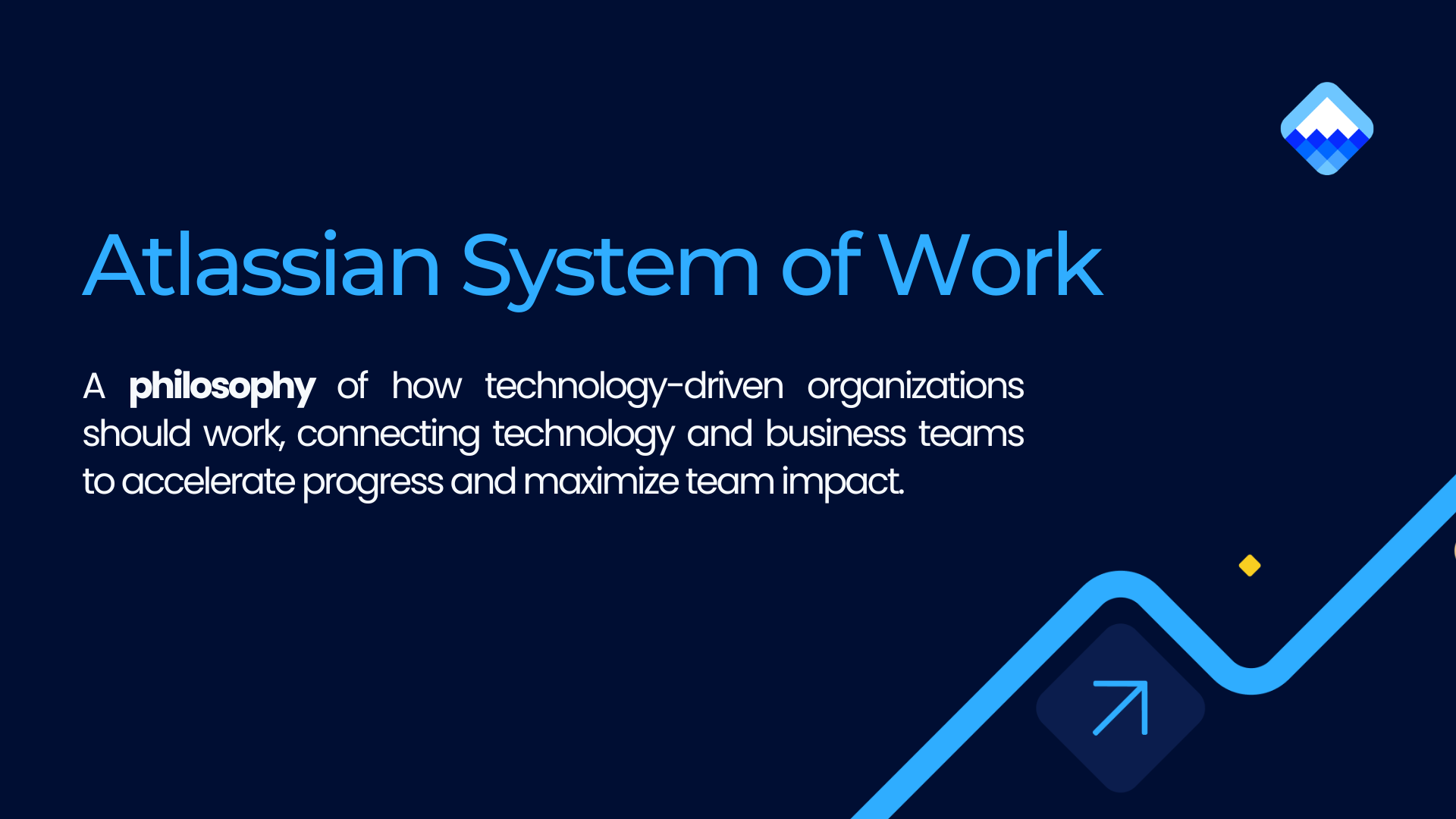
At its core, the Atlassian System of Work is an approach designed to help organizations connect their strategic objectives with the day-to-day activities of their teams. It is not simply a collection of software tools. Instead, it is a framework that combines people, processes, and technology to create a more connected and transparent way of working.
The goal is to make work more coherent. No more information isolated within individual teams or systems - the System of Work creates links between strategy, planning, execution, and outcomes.
This means that employees should be able to understand how their work contributes to broader organizational goals, leaders should have visibility into progress without requesting manual reports, and teams should collaborate more effectively because they share the same context.
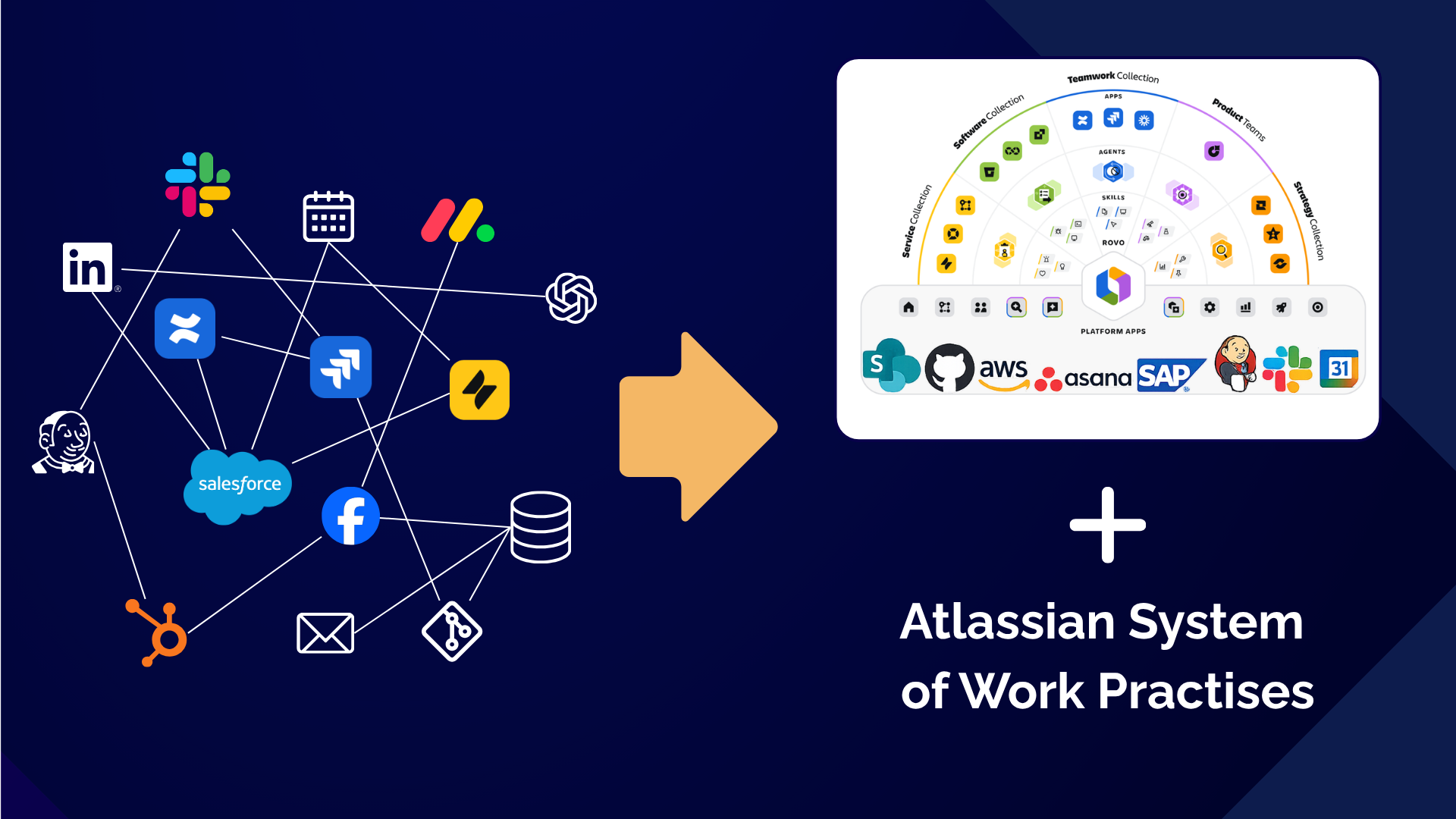
It all sounds great, but how can you actually achieve that? This is possible thanks to combining all these sources into a single platform.
.png)
Atlassian System of Work Philosophy
Historically, many organizations adopted Atlassian products such as Jira and Confluence as standalone tools. Jira helped teams track work, while Confluence became a place to document knowledge. Organizations were free to configure these platforms according to their needs. Over time, however, businesses began to expect more than isolated tools. They needed solutions that supported complete ways of working rather than individual functions.
As a result, Atlassian shifted its focus from individual applications to integrated capabilities designed around business needs. Organizations are encouraged to consider how different teams collaborate and how information flows throughout the company. Not just how to solve a single problem - such as tracking work progress - but how to create an entire collaboration system.
Atlassian System of Work Principles
- Align work to goals: Calibrating expectations and progress against a common understanding of outcomes and progress.
- Plan and track work: Ensuring that everyone, from leaders to individual contributors, understands where key projects are today and what’s next.
- Unleash knowledge: Keeping critical information flowing across and between key teams, so everyone can share context and find information more easily.
- Realize the full power of AI teammates: Successful teams embed AI as part of the team.
Create a single source of truth
One of the biggest obstacles organizations face is fragmentation.
Development teams may use one platform to manage code repositories, service teams another system for support requests, and leadership teams separate tools for strategic planning. Valuable information exists across all these systems, but bringing it together can be time-consuming and expensive.
The Atlassian System of Work aims to create a single source of truth, where relevant information is connected and accessible across teams.
Stakeholders no longer need to schedule additional meetings to understand the project's status; they can see the progress right away. Rather than manually combining reports from multiple systems, leaders should have visibility into goals and delivery in one place.
Communication still remains important, but thanks to the System of Work, it can be supported by a single source of knowledge at all levels - from specialists, managers, help desk staff, to C-level executives.
Aligning daily work with company goals
Many companies have well-defined strategies. Senior leaders often know what the organization's priorities are and where they want the business to go.
The challenge arises when those strategic priorities fail to translate into everyday work.
Teams might get projects done quickly without really knowing how their work fits into the bigger business goals. Also, leaders might have a hard time keeping track of how their strategic plans are going.
The System of Work is the solution for this problem - it links strategic goals directly to operational work. Projects, initiatives, and tasks are linked to what the company is focusing on, which makes it clear to everyone from the executives to the regular employees.
The following questions still arise, but now we can answer them with greater confidence:
- Which initiatives contribute to our strategic objectives?
- Are we making progress toward our goals?
- What obstacles are slowing us down?
- Where should we focus our efforts next?
Better cross-team collaboration
Modern organizations rarely operate in isolation. Software developers depend on service teams, product managers work closely with engineering departments, marketing, legal and HR resolve requests, and leadership relies on accurate information from across the business.
Despite this reality, many companies still organize their work in disconnected systems that create barriers between teams.
The Atlassian System of Work encourages collaboration by making information available across functions. Teams can work within their own areas of responsibility while maintaining visibility into how their activities affect others.
For example, developers are often on the third or fourth line of support. If the help desk team wants to assign a task to them, they need a system to do so. One possible way of working would be to put developers in the Jira Service Management, but we can find a more effective solution.
And you don't have to switch between apps. In the Atlassian System of Work, we can integrate both workspaces. You can see all your tasks from Jira and Jira Service Management in one place. We've got a role just for that - the contributor. You can use it without any licenses, so developers can display board tasks from Jira Service Management, put them on the backlog, or do whatever they need to with the task.
How Atlassian supports an open ecosystem
An important aspect of the Atlassian approach is that it does not require organizations to use only Atlassian products.
Many businesses have invested heavily in existing tools and systems. Replacing everything is often unrealistic and unnecessary. Instead, the System of Work is designed to integrate with a wide range of technologies.
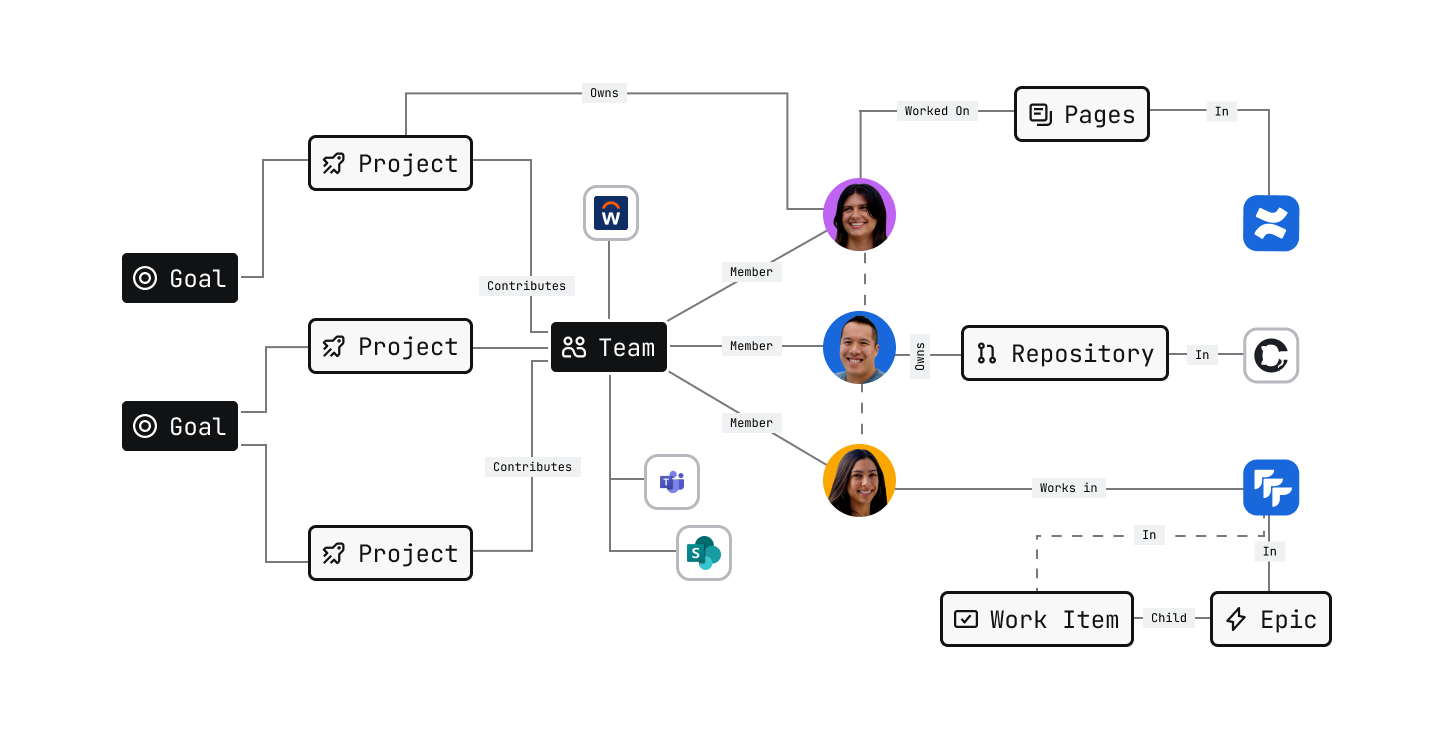
At the core of the Atlassian System of Work are the Teamwork Graph and an open platform. If you want to replace any of the Atlassian products, you can do so - for example, by integrating with GitLab or ServiceNow.
Teamwork Graph is Atlassian Cloud Platform’s data intelligence layer and it captures content from all of your work, across not just Atlassian products, but also other third-party solutions that you use.
What are the Atlassian tools included in the Atlassian System of Work?
First, a reminder: The System of Work isn’t a single product, but a philosophy in which all tools work together on a single platform.
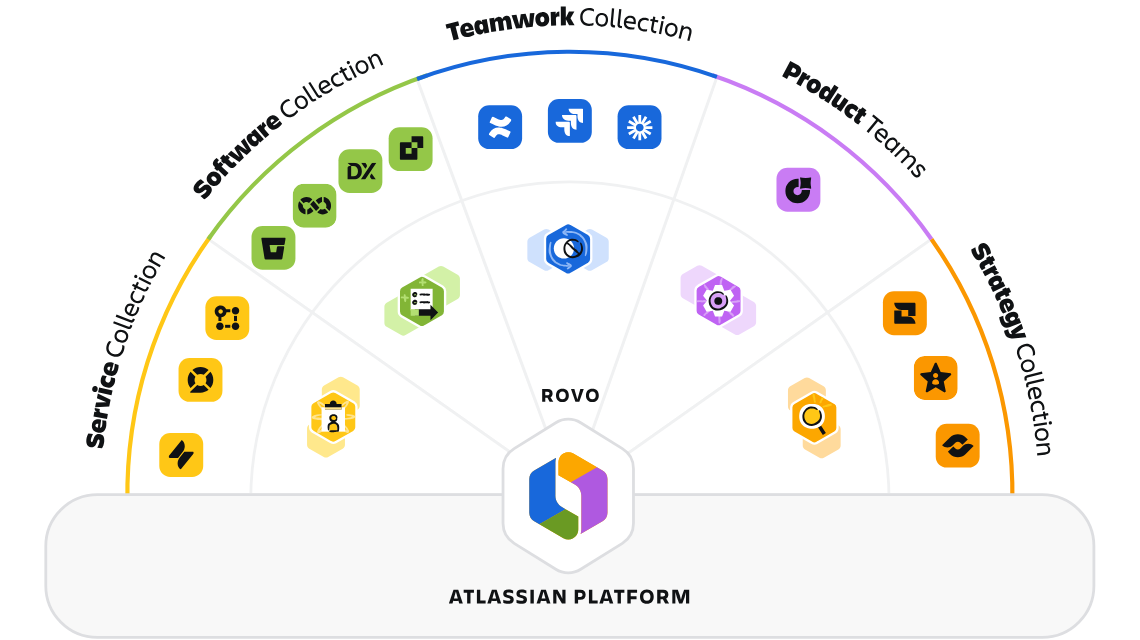
Atlassian apps have been organized into Collections that cover most of a company's needs. Most of the products can also be purchased separately from the Collection bundles, as a single product.
It's a bit like a jigsaw puzzle - the pieces come together to form the complete picture.
You can read about license prices and a description of tools in this article.
Current available Atlassian Collections:
- Teamwork Collection - Jira, Confluence, Loom, Rovo
- Strategy Collection - Focus, Talent, Align (available for more than 50 users only)
- Service Collection - Jira Service Management, Customer Service Management, Assets
- Software Collection - Rovo, DX, Pipelines, Bitbucket, Compass
- Product Collection - Jira Product Discovery, Feedback, Rovo
Fact: Many customers don't realize that if they have Jira and Confluence, they can also get Loom included in the price if they purchase the Collection.
Real-life example: Cisco Case Study
For Cisco Networking, the largest business unit within Cisco, supporting more than 90,000 employees meant finding a better way to work across a highly complex and distributed organization.
As the company continued to grow, teams were losing valuable time due to fragmented processes, disconnected tools, and inconsistent ways of working. Information was spread across numerous systems, making collaboration difficult and reducing visibility across projects and portfolios. Even basic concepts such as what constituted a program, feature, or workflow state were interpreted differently by different teams, creating barriers to effective cross-functional collaboration.
They struggled with the problem many companies face - tools and information living in silos, disconnected and fragmented.
When the company decided to stop supporting its legacy work management product, the team seized the opportunity to consolidate and migrate over 75 tools and instances to the Atlassian Cloud platform.
They could’ve “just” migrated to Atlassian Cloud, but instead they made this platform a central point connecting everything they work on.
Working closely with Atlassian Advisory Services, the company designed and implemented an Atlassian System of Work built on Atlassian Cloud Enterprise. The goal was to consolidate tools, but also to create a connected operating model that would support collaboration, visibility, and decision-making at scale.
Cisco set up before:
- 70+ Jira Data Center instances
- A large, aging work management product
- Nearly 75 other tools
- Endless workflows and documents in Excel, Word, PowerPoint, and SharePoint
- Nine environments within Aha!, another software development tool
The results
The new System of Work brought these disconnected environments together into a single platform. Teams gained a shared way of working, common terminology, and real-time visibility into projects and dependencies. Instead of relying on static reports and presentations, they could access live data directly from Jira and Confluence.
One of the most visible improvements was the replacement of traditional status reporting. Previously, teams spent hours each week preparing PowerPoint presentations for leadership updates. Today, program status, approvals, and project health are managed directly within Jira, while Confluence provides real-time reports and dashboards connected to live project data.
According to Amy Hauth, Senior Director of Business Operations, this has made the process 24x faster: “Getting teams to do their status updates in Jira instead of PowerPoint and creating real-time reports and dashboards has been really powerful. What used to take two hours every week is maybe 5-10 minutes now.”
Cisco Networking is also using Rovo with Forge, Atlassian Cloud’s app development platform, to enable anyone to build custom apps and automations.
The business impact has been significant. Since implementing its Atlassian System of Work, Cisco Networking has reduced annual tooling costs by 54 percent and reinvested 40 percent of operational expenditure back into the business over a three-year period without reducing delivery capacity. The organization also spends 30 percent less time dealing with tooling-related issues, allowing teams to focus more on innovation and continuous improvement.
Why AI Makes the Atlassian System of Work Even More Important
Artificial intelligence has become a major focus for organizations across every industry. Many companies are experimenting with AI-powered assistants, automation tools, and intelligent search capabilities to improve productivity.
However, there is a challenge that is often overlooked: AI is only as useful as the information it can access.
If knowledge is scattered across multiple systems, if teams work in silos, or if data is inconsistent and outdated, AI struggles to provide real support. Faster access to incomplete or inaccurate information does not solve underlying organizational problems, but creates even more of them.
Rovo (Atlassian’s AI) is designed to work within the broader context of an organization's knowledge and workflows. It can draw information from Atlassian products such as Jira and Confluence, as well as from external systems used across the business.
This is one of the reasons why Atlassian places such a strong emphasis on the System of Work.
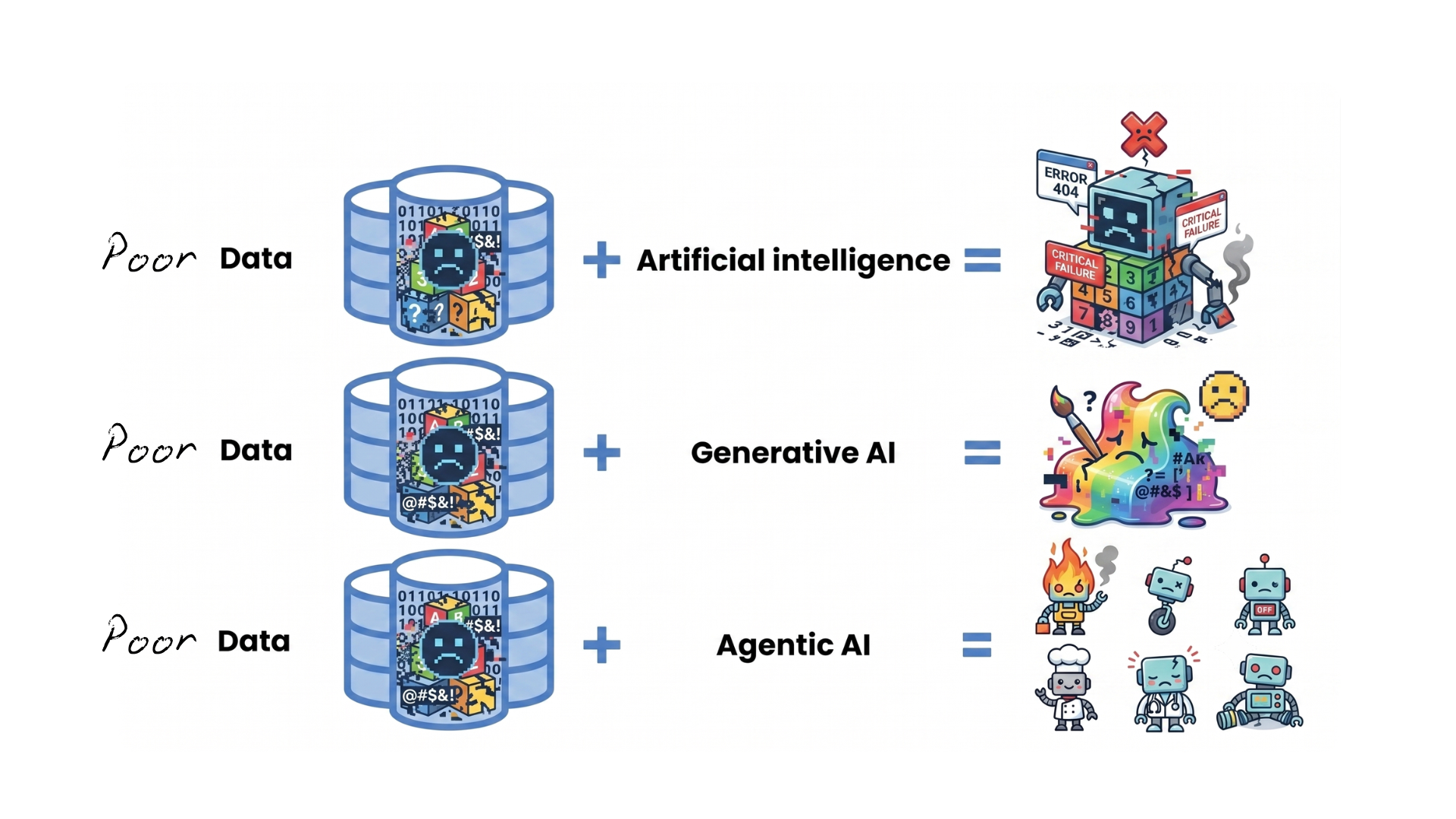
Instead of just thinking of AI as a standalone thing, Atlassian sees it as something that is built on top of connected teams, sharing what they know, and using workflows that are all connected. The idea is simple: when work, documentation, goals, and operational information are linked together, intelligent tools can help people find answers faster, reduce manual effort, and make better decisions.
And that brings us to the core: successful adoption of AI depends less on the technology itself and more on the quality of the underlying work environment.
Organizations that have clear processes, connected systems, and accessible knowledge are in a much stronger position to benefit from AI.
Those with fragmented information and disconnected teams may discover that introducing AI simply exposes existing inefficiencies rather than solving them.
In this sense, the System of Work provides a foundation for making AI genuinely useful by connecting strategy, teams, and operational data. Organizations can create the context needed for intelligent tools to support everyday work effectively.
The conversation therefore shifts from asking, "How can we implement AI?" to a more important question: "How can we organize our work so that AI can help us deliver better outcomes?"
For Atlassian, the answer begins with building a connected System of Work where people, processes, knowledge, and technology operate together rather than in isolation.
Why choose the Atlassian System of Work?
- Align strategy with execution by connecting business goals to projects, tasks, and team activities.
- Reduce information silos by connecting teams, tools, and knowledge in one ecosystem.
- Get real data for decision-making with easier access to up-to-date information and project status.
- Create a single source of truth for work, documentation, goals, and operational data.
- Minimize time spent searching for information across multiple systems and departments.
- Help teams use the same process, workflow, and language by providing shared context and common ways of working.
- Reduce tooling complexity through integrated workflows and native connections between products.
- Help standardize ways of working across departments and business units.
- Build a solid foundation for AI with consistent data.
The Atlassian System of Work reflects Atlassian’s transition to a more customer- and ecosystem-friendly product portfolio. The product Collections are designed to fit the business needs of each team. Leaders can track progress against goals, and departments won’t work in isolation anymore. The System of Work introduces a philosophy in which the Atlassian platform becomes the central command hub for teams, as well as an open environment.
If you're looking for a trusted partner to help you implement the Atlassian System of Work, please contact us via form on our website or book a demo.


Marketing and creativity fairy, responsible for branding, content creation, and promoting our services. With an academic background in cybersecurity and a passion for marketing, she combines the best of both worlds. If you're looking for a conversation starter, Canva designs and good books are always great topics with her!
%20(1).png)
Wojciech helps organizations make Atlassian solutions work for them, not the other way around. He’s always believed that great implementations need more than configuration - the right approach, clear standards, and a strong delivery environment. Outside of work, he describes himself as a fan of all kinds of boarding (snowboarding, surfing, skateboarding, etc.). He also enjoys mountain biking and travelling to lesser-known places with very different cultures.

Simplify tasks and teamwork with Atlassian

Unlock business growth with Salesforce

Transform your data into smart decisions with Splunk

.png)
.png)
